Monday, September 13, 2010

Author Study--Joseph Bruchac


            I chose to study Joseph Bruchac because I had no idea who he was or what he had contributed to the world of children’s literature. I was pleasantly surprised to find that his work is often inspired by his Abenaki heritage, and he writes of Native American life and folklore stories passed down through the generations of the Abenaki culture. While he has written extensively literature and poetry geared towards adult audiences, he began writing for children and young adults in the 1990s and continues to do so through the present.
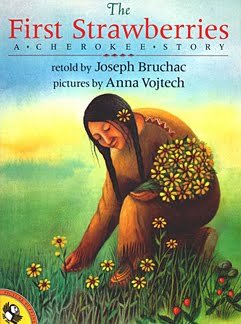
           Two of his children’s books that stuck out to me included The First Strawberries and Raccoon’s Last Race. Like many of his stories, these are two old Native American tales that explain something about nature and the world while also teaching a life lesson. The First Strawberries tells of how this fruit came to be, and I was drawn to it because of its universally applicable lesson that comes out of a seemingly simplistic story. All that happens is an argument between a husband and wife, and while the woman is walking away, she is stopped by the beautiful strawberries and is delayed there long enough for her husband to catch up with her and apologize. However, this story reminded me of all of the things in life that can sometimes get the best of us and cause anger or frustration with those around us. I think this would be a great lesson to talk to students about, because we all have bad days and feel like the world is against us. However, if we just stop to enjoy the little pleasures in life, we realize that we don’t have it that bad after all.
            Raccoon’s Last Race also presents a situation that we can learn from. Azban the raccoon is conceited and boastful of his ability to run faster than the all of the other animals, but that is soon taken away from him when he gets squashed by a boulder during yet another race. According to the tale, this is how raccoons ended up with a flatter body and short legs that are not as suitable for running.
            While I am a bit wary of choosing books that are heavily weighted towards teaching a lesson, I think Bruchac’s books can still be valuable literature in the classroom. Native American legends like these teach us to be a good friend to others and to evaluate where we find meaning in our lives. These are themes which I can ease into the curriculum as a teacher to remind students that we should be respectful of each other, listen when others are speaking, etc. More relevant, however, is the fact that Bruchac’s writing can be utilized within a unit about Native American cultures. Like his Abenaki tribe, a lot of Native Americans use folktales to teach their children and show them the path they should take in life. I think it’s important for students to learn about Native American literature and the purpose behind why these stories have been passed on through the generations. By showing students that Native American tribes use literature to teach life lessons, they can begin to develop a respect and understanding for this element of the Native American culture.

Because of Winn-Dixie

Because of Winn-Dixie by Kate DiCamillo
            Children’s Novel—Ages 9-12
            Rating: 5 Stars (out of 5)
            Summary: This is the story of ten-year-old India Opal Buloni and the summer that she finds a dog. Winn-Dixie, named after the town’s supermarket, helps Opal to meet a lot of new friends and realize a lot about herself throughout the course of the summer.

            Because of Winn-Dixie is a great story about both friendship and loss. Opal has been raised by her father because her mother left them when she was still young. As I was reading, I felt a heart-wrenching feeling of sadness alongside Opal because she constantly thinks about her mother and mourns the fact that she doesn’t know much about her. Opal’s struggle with this experience made me pause and reflect on how lucky I have been to grow up in a family with both parents. I think I often take this for granted—even in the midst of a world where divorce is far too common and I know plenty of people whose parents are no longer together. Because I have not gone through this, I had a hard time relating to Opal. However, the text is written in such a way that her feelings are raw and out there for the reader to observe. As the story develops, Opal finds that a stray dog, Winn-Dixie, has a knack for socializing and helping her to make friends in her new town. Winn-Dixie quickly becomes part of the family, and I could relate to Opal’s rapidly growing love for him. It reminded me of the bond that my family instantly formed after adopting our dog from a shelter when I was in middle school. Lastly, Kate DiCamillo masterfully tailors the dialogue to capture a laid-back southern dialect and give us a snapshot of the characters in their truest form. I felt as though I was sitting in on each conversation and developing a personal relationship with the characters.
            I think students would find it easy to relate to this book—whether to the loss experienced by Opal, her desire to make friends, and especially the difficulties she has with getting along with some of her peers. This novel would also be a good base to discuss the ways that people from around the country use language differently. In fact, I think this topic would have to come up in reading this book because there are many examples in the dialogue of incorrect grammar and slang that might confuse students and challenge how they write. As a teacher, I would like to see how students might react to the obvious dialect, if they react at all. I think it would be important to reassure them that it is not wrong, but rather just a representation of how people talk and certainly a feature of writing that can make the story much more interesting.

Sunday, September 12, 2010

Canoe Days

Canoe Days by Gary Paulsen, ill. by Ruth Wright Paulsen
            Picture Book—Grades PreK-3
            Rating: 4 ½ Stars (out of 5)
            Summary:  A man in a canoe glides along a lake, enjoying and becoming one with the peace and beauty of the nature surrounding him.

            I felt an instant connection with Gary Paulsen’s Canoe Days. My family camps and enjoys the outdoors to the fullest extent, and so I share an appreciation for the beauty that Paulsen describes in this story. When I was young, my family took many vacations to Wisconsin, where we stayed on a lake and went canoeing as a tradition. The lines are poetically written and seem to glide across the pages and off of my tongue to match the seamless gliding of the canoe across the lake’s surface. Paulsen also personifies the many animals encountered in the story, which helps to bring them to life, along with the interest created by the use of similes and metaphors. I could almost close my eyes and feel myself sitting alongside the man in his canoe, which is precisely what I find most effective about this story. Its lyrical flow and richly painted illustrations perfectly capture the serenity of nature that is found on this lake and in nature everywhere.
            As a teacher and lover of nature, I intend to instill an appreciation for the outdoors in my students. Sometime during the school year, I hope to study nature and incorporate elements of both science and literature when doing so. I believe Canoe Days would be a great story to share, not only in relation to my personal experience with nature, but also as a great piece of literature to enjoy. By using this story almost in the context of poetry, students can learn how to find inspiration in the world around them to explore and write about. However, I think I would need to be careful not to have unreasonably high expectations for my students just because they are studying nature. In other words, what I find beautiful and inspiring may not elicit the same emotions in them. This text could also be used by students to learn about how to enrich writing with fuller descriptions and the use of devices such as simile and metaphor, since it provides such wonderful examples of these and other strategies to make your writing more interesting.

No, David!

No, David!  by David Shannon
            Picture Book—Grades PreK and Up
            Rating: 5 Stars (out of 5)
            Summary: David seems to constantly find trouble and be reprimanded to stop being bad, but is finally consoled with a hug.

            No, David! is the author’s depiction of himself as a young boy. This story captivated me as a reader because I could definitely relate to the series of scolding that young David receives. In fact, I think everybody could remember themselves as having a little David in them growing up. When he is fooling around in the bathtub and splashing water everywhere, the illustration reminds me of myself as a child. I know that I was reprimanded for splashing my mother during bath time, but who can blame poor David when he has all of those awesome toys to play with? Sometimes as a child, it seemed like the only word I heard was “No,” and this is definitely what David is experiencing. My favorite thing about this book is that the words are so simple and repetitive, but the pictures supply so much depth. I spent quite a long time on each page just taking in the illustrations in sheer amazement at the story they provide which is absent from the text. As a reader, I got a sense of David’s disobedience from the words, but was really able to see his personality through the devilish grins. The illustrations also made me laugh along to see the joy on his face as he is causing trouble and having so much fun regardless of the scolding from his mom. At the end of the story, David finally seems affected and is given a hug by his mom, who says, “Yes, David…I love you!” This was a great reminder that at the end of the day, parents will love you no matter what.
            No, David! is an easy read and would be great for young kids because the repetitive nature would help them to learn and read it. However, I think this book would work with older students as well. Its message is simple but significant, and so I would use this story to talk about the message that is intended—that no matter what, our parents will always love us. As a teacher, I think it would be important to share a personal story of a time when I misbehaved to show students that we all make mistakes and can be forgiven. This message can then be applied to classroom behavior to remind students how much I care about them even if they do something wrong. Finally, this book could also be used with students to encourage them to pay attention to and pull out information from the illustrations. I think No, David! would be an excellent choice of literature to practice this strategy. So much of the action relies on the pictures and the text is simple enough that it would allow students to make independent discoveries of what they can learn from a book’s illustrations.

The Car Washing Street

The Car Washing Street by Denise Lewis Patrick, ill. by John Ward
            Picture Book—Grades 1-4
            Rating: 4 Stars (out of 5)
            Summary: Matthew and his father sit out on their stoop on a Saturday morning watching all of the neighbors wash their cars. Matthew loves living on the car washing street because something crazy always happens.

            The Car Washing Street is a special story that brings back a lot of memories of the street I grew up living on. Just as Matthew looks forward to the Saturday morning ritual of car washing, I could not wait for the warm summer nights to roll around on my street. As a kid, I would constantly be running around outside with my brother and the several other kids on the block. We would goof around on our bikes or in somebody’s sprinkler, and the water fight that Matthew has with his neighbors in the story is reminiscent of what we would end up doing with the hose out on the lawn. Patrick’s subtle use of alliteration spruces up the text, but other than that, the writing is lacking in any sort of flair. However, I think this is fitting for the story, as it is told just as you would see it if you were sitting on the stoop with Matthew observing the action—it is pure and simple in flavor as it describes what is happening. At the conclusion of the water fight, the group is brought together by some cool refreshments sold by a street vendor. As they unwind with their ices on a stoop, I felt a warm sensation of togetherness that reminds me of the bonding my family shared with our neighbors—an experience that I think is dying out in neighborhood living today.
            In the classroom, I think this story would work well as a preface to a writing exercise. I know that writing about personal experience is easy and students often enjoy the retelling of something that happened over the summer, during a school break, etc. Therefore, we could have a short sharing time and then the students can use The Car Washing Street as inspiration to write about a similar occasion when they had fun just playing around. With this story, I would also emphasize the importance of bonding with friends and family over the simple things—events that happen every day and aren’t necessarily a special occasion. I think we can always gain from a reminder to enjoy the little things in life and remember to play and have fun. 

Friday, September 10, 2010

Mudball

Mudball by Matt Tavares
          Picture book—Grades 1-4
          Rating: 5 Stars (out of 5)
          Summary: Mudball depicts the legendary story of little Andy Oyler, the shortest player in the baseball league. While he has never gotten a hit before, fate seeks to change Andy’s luck on a rainy day in 1903.

            Mudball is a story that I can definitely relate to as a reader. I played softball for many years and grew up in a family that loves all aspects of baseball. At first, Andy Oyler just seems like your typical underdog hero, but this story has so much more to offer. As I was reading, I recalled the many games I played in the rain and how difficult it was to run out onto the field every inning in those conditions. I also experienced many slumps in which it almost seemed like I would never be able to hit the ball again—and so I know how Andy was feeling as he went up to bat amidst the jeers from the crowd. I think the feeling of defeat is far too common, especially as young kids are immersed into the world of sports at such a young age and often pressured to do well by parents, coaches, and peers. The expectation for children to succeed athletically is an unrealistic one because kids develop at different rates and do not even have control over their motor skills until adolescence. Therefore, Mudball contains a good lesson by demonstrating that you don’t always have to be the best to be the hero, and more importantly, sports are most valuable when we are out there to simply have fun. Tavares effectively conveys this message of fun and builds the story’s excitement through his use of dialogue. As the players frantically search for the ball in the mud puddles, I felt myself on the edge of my seat with every exclamation they shouted, placing me in the moment with them and making me feel like a part of the action.
             As previously mentioned, I think this story shows us the importance of having fun with a sport, even if you’re not the best player. Relaying this message to kids is important, and that is how I would use Mudball in my classroom. I’m not exactly sure if it would fit nicely within a specific theme or unit, unless we were talking about sports. In sharing this book with children, I would really hope that they could learn from Andy Oyler that you can still make a big difference even if you’re not a natural athlete or the star player on your team. For this to set in with students, I think it would be useful to first share my own experiences playing softball as a kid and let them know that I had struggles of my own. As their teacher, this would be good for them to hear that something they might experience is not uncommon and that we all go through phases of feeling like we are not as talented as our peers. Finally, I would try to transfer this message to the classroom and talk about our differences in abilities in school as well. It would be a good opportunity to discuss how we sometimes fall short of what is expected of us in school, but that it is okay and we should always keep trying and bring our best effort to the plate, just as little Andy Oyler did.

William and the Night Train

William and the Night Train by Mij Kelly, ill. by Alison Jay
            Picture book—Grades PreS-K
            Rating: 4 out of 5 stars  
            Summary: William and his mother, along with an array of people and animals, board the night train on its way to tomorrow. William is wide awake and wants to get to tomorrow quickly, but the train won’t leave until he is asleep.

            Reading William and the Night Train made me feel like a kid again. Much of the story follows William as he wildly bounces from train car to train car and is simply too excited for tomorrow to come that he cannot go to sleep. I remember being tucked in by my parents but feeling the exact same anticipation as William and wishing that it could just be tomorrow already! Especially when we would be leaving the next morning for our summer vacation, I know that I spent many nights as a child wide awake in bed and starring through the dark thinking about everything that we had planned for our trip. I also connected with William’s experience as his mother tells him the quickest way to tomorrow is to close your eyes and go to sleep. It’s funny that I can recall my mom saying the same thing to me, and I would wake up the next morning with the realization that she was right—the night flew by once I was asleep. The motif of this story—a train taking you to tomorrow—reminded me of The Polar Express by Chris Van Allsburg. The charm of this book also stems from the disproportionate characters and array of circus animals that board the train along with William. It makes me want to hop on board and join the fun—I wouldn’t want to sleep either with all of the excitement around!
            I would definitely consider using this book in my future classroom. After sharing it with a couple of students, however, I do have some hesitations. The two second grade girls that I read this to really enjoyed the story and especially loved the illustrations. They had fun pointing out the different people boarding the train and seeing that there were little piglets in one of the cars. However, it took them a while to grasp the idea of a train going to “tomorrow” as a time frame rather than as a location, since that is what they know of where trains take you. One girl was laughing as she asked me if “tomorrow” was really the name of a city somewhere, and so I did my best to explain the train ride as a metaphor for going to sleep. In the end, I think they both understood; however, I would discuss this concept more thoroughly as we read through if I were to use this story in my classroom. I think it would also be helpful to have a class discussion and have students share a time when they were so excited that they couldn’t fall asleep, and maybe that would help set the stage for this story. To fit it in with a certain theme, I might read it when we are coming up to a holiday or break and tie it in with plans that students have during their time off. Otherwise, I think this book would also be great just as a fun read-aloud at the end of the school day.