Showing posts with label Focus Question. Show all posts

Friday, November 5, 2010

Jacqueline Woodson Experience

            While I had never heard of Jacqueline Woodson before being assigned to read one of her novels, I am now very intrigued by her as an author. I love that she takes risks in her writing and touches on subject matter that many would stay away from, but yet is very beneficial for students to come into contact with and learn from as they grow into young adults and become increasingly more immersed in society.
            I read Woodson’s Hush, which I wrote about here, and as we discussed and related our novel to some of her other works, many common elements and themes were found across her writing. One of the major themes present in both Hush and The House You Pass on the Way is identity. Characters in both novels struggled with who they were and what defined them as people, which is a question that many of us deal with in the real world. Woodson’s approach to this theme involved exploration of identity, and I’m not sure that either of these book’s characters really came to any solid conclusion about their identity. In this way, I think Woodson navigates the question of identity in a rather peculiar way. For instance, it is strange to me that Evie in Hush would spend almost the entire book wondering who she is and trying to find a place for herself, only to be left as the reader still questioning that same thing. It’s true that Evie found a place on the track team, but I felt like she was still searching for something deeper. However, this interpretation of identity closely parallels reality in that I don’t think we ever do truly find our identity and can say that who we are is permanent. Rather, identity is something that is fluid and ever-changing as the seasons. As humans, we are constantly forming and reforming the critical elements of our lives that make up our identity, and so I find it fascinating that although this is what Evie was searching for, Woodson ends the novel absent of a final conclusion for this question.
            Woodson also tackles the idea of keeping memories alive in some of her literature. For example, this is a big part of Evie’s life as her family enters the Witness Protection Program and is also a major theme in her picture book, Sweet, Sweet Memory. In this story, Sarah and her family mourn the death of her grandfather, but find solace as they reminisce about things that he used to say and do. Woodson’s attention to the importance of memories is slightly bittersweet in Hush because it is Evie’s desire to return to the place of those memories that causes so much pain and hardship. Her family must move on and will never be able to go back to Denver, and Evie struggles to accept this fact and let go of the past. However, Sweet, Sweet Memory uses the past as a comforting element for Sarah after the passing of her grandpa. After remembering the words he used to say, she is able to share her own memory of him and smile. I think it’s interesting that Woodson uses the element of memories for these two very different purposes. However, the idea that memories should be preserved still prevails in both stories, as Evie eventually realizes that she doesn’t have to let go of the past in order to take comfort in the future.
            Overall, I think Woodson is unique in that a lot of her stories share a common thread, whether it is the challenges of finding ones identity or the importance of keeping memories alive. I think students would definitely benefit from reading her work, as they would certainly face difficult questions as they approach the struggles that characters like Evie face. However, it is through such questioning as we read that we are able to grow, and Woodson definitely provides many opportunities to do just that.

Tuesday, October 26, 2010

The Giver

The Giver by Lois Lowry
            Children’s Novel—Science Fiction
            Grades 6-9
            Rating: 5 Stars
            Summary: When Jonas is assigned to be the next receiver of memories in his community, he discovers a hidden world of feelings, colors, and experiences that everyone in society is sheltered from. After seeing the injustice in this way of life, Jonas and The Giver devise a plan for Jonas to escape and release the memories to the community.

            I have never been a huge fan of the science fiction genre. When I think science fiction, I often see images of outer space, robots, and futuristic technology. The Giver introduced an entirely new perspective to me in regards to this genre which I had previously overlooked. In many ways, Jonas is a person just like me…he has a family, he goes to school, he plays with friends. The twist in this novel is that Jonas exists in a community that has placed such tight restrictions on its members that Jonas and everyone he knows has been prohibited to lie, sense color, and feel. In many respects, they are forbidden to live in the way that we as humans are meant to live.
             One of the most intriguing elements of The Giver is Lowry’s construction of place. Many authors create an enhanced version of the world as we know it, often allowing us as the reader to experience something that is thrilling and magical when we dive into their stories. However, Lowry’s construction of place is a society which is deprived of the essential elements that make the real world what it is. This is what elicited an eerie feeling of emptiness for me as I made my way through the pages of The Giver. I cannot imagine living in a world that does not know the happiness of Christmas and family, or the delight of sledding down a snow-covered hill. Even pain is something that helps us make meaning out of life, but this is a feeling that Jonas experiences for the first time at age twelve and something that is foreign to the rest of the community. The inability to feel was a strange thing to witness, and this conception of a place with restrictions on such things is what ultimately set the mood for me in this story (Peterson & Eeds, p. 45).
            Time is another element which Lowry uses in a rather unconventional way. There is the normal passage of time through the months, but if you think about, the grander concept of time is very skewed for the members of the community. Jonas is able to experience memories of the past, almost as flashbacks, but the rest of society remains ignorant to their very own history. The idea that his parents had parents at one time is even a surprising revelation to Jonas, which shows how the idea of a past is just not relevant to how these people live. While time for them is passing, to the reader they almost seem to be standing still, living in the moment, because the minute someone is old enough to leave, they are gone and forgotten about. This idea is actually quite difficult to wrap my mind around, but maybe this is what Peterson and Eeds are referring to when they talk about time being “ordered psychologically” so that it seems to have stopped (p. 53). Overall, this is another aspect of the novel that contributes to the mood and feeling of uneasiness, which makes it an effective science fiction read.
            The ending was, for me, the climactic peak of tension that had been slowly building since Jonas and the Giver started meeting. As Jonas becomes more aware of the restrictions and injustice that the community imposes on its members, I felt that this caused a climbing tension as he becomes increasingly enraged with the lies that he had been told all his life. With his decision to escape, I felt a sense of victory over the inner conflict that Jonas experiences between the life he has known and the new experiences that the Giver has shown him. Jonas and Gabe battle some rough conditions in their escape, and even though the ending can be interpreted as the death of Jonas, I really don’t think he dies. I think that because he has arrived at the spot of his first pleasant memory that he received from the Giver, this must be the start of a new life as he sleds down the hill towards the house filled with music and light. 

Monday, October 11, 2010

The Higher Power of Lucky

            What I loved most about reading The Higher Power of Lucky is that there is a little bit of Lucky in all of us. At some point in our lives, we all search for something more and feel like we are all alone in our struggles. Susan Patron’s characterization of Lucky is so successful because of this fact—she is completely relatable. She just wants to know that after losing her mom and never really knowing her dad, she will have some security in her future. When this is challenged by her suspicion that Brigitte is going to go back to France, Lucky decides to take matters into her own hands and fend for herself. When I was younger, I remember feeling like my parents were never coming back when they would leave me and my brother with a babysitter. Lucky’s way of coping with her situation is a bit more dramatic that I was as a child, but either way, the need to feel wanted is important when we are young.
            At first, it seemed odd to me that Patron told the story in the third person. Lucky’s feelings seem so raw and vulnerable that it is easy to think that we must be seeing through her perspective, but that’s not true! I think what makes this choice effective is that we still are empowered to know everything that Lucky is feeling. Had there been any more distance between us as the reader and Lucky as the main character, a lot of meaning would have been lost. Peterson and Eeds (2007) say that authors writing in the third person can “choose to let us view everything that happens through the eyes/thoughts/feelings of a limited number of characters” (p. 51). This is the case in Lucky. We never have access to the thoughts of Brigitte and must rely on Lucky’s perception of her, which is why for most of the story we become entangled in the fear that Brigitte is going to leave Lucky. Through this aspect of her writing, Patron creates a mood for us as the reader that is easily influenced by Lucky’s perception.
            Mood plays an important role in Lucky. As I just mentioned, it is influenced by the fact that Lucky’s viewpoint is pervasive and Brigitte’s is not. I spent most of the story worrying right alongside Lucky that Brigitte is going to leave her. This worry helped me to connect on a deeper level with Lucky and I found myself wondering what I would do in the same situation. Lucky is a lot more bold than I am, and I don’t think that I would run away like she did. I did, however, feel a genuine concern for her, and this connection was created through my access to Lucky’s emotions. Mood also functions as an avenue for tension in literature (Peterson & Eeds, 2007, p. 55). Tension definitely increases when Lucky sees Brigitte’s passport and decides right then that she needs to take action. When she comes to the conclusion that she will run away, I became nervous and concerned that she was making a mistake.
            Overall, The Higher Power of Lucky is a story that is true to the emotions and struggles of its main character. As a reader, I enjoyed following Lucky’s journey and her growth as a result of it. As she goes through her struggles and eventually learns to cope with her fears, Lucky’s relationships evolve with other characters, including Miles, Lincoln, and eventually Brigitte. The fact that her character is dynamic and changing lends itself to the other elements of the story as well, creating a nice balance and enhancing the piece as a whole.

Monday, September 27, 2010

Literary Elements

            Literary elements are the meat and potatoes of a story—without these, I’m not sure what a story would even look like! They provide structure and balance, create mood, and if used effectively, stir enough interest to draw the reader in. Character, point of view, time, place, plot, mood, symbol and extended metaphor, and theme all stand on their own as uniquely important elements of a good story. However, for me, character, point of view, and place are especially critical in drawing me into the pages of a book.
            When I think of character, my mind automatically goes to the main hero or heroine of the great books I have read. However, character can also be portrayed through the setting, and includes all of the people in a story. Big or small, every role contributes to the plot and somehow influences a story’s outcome. Perhaps the most exciting element of character is how they change. Without character growth, the story would seem stale and the action stagnant. An author whose stories rely on the growth of her characters is Laura Ingalls Wilder. In her Little House Series, readers are invited to share in the transformation of Laura and the rest of her family as she copes with loss, triumphs over adversity, and celebrates the good things in life. As a child, I was enamored by Laura and her strength as the leading lady in the Little House books. Her character demonstrates the rich potential of all human beings and gives the reader a model for dealing with life’s everyday trials. In addition, we see the dynamic that is created between characters as new people are introduced with every book and each new adventure. This dynamic between characters is an element that I look for in books, as it adds depth to the plot and shows us the emotional side of a story’s characters by observing their interactions with others. These components are just a small insight into the intrigue that character adds to a story.
            Point of view is an element of literature that plays closely alongside character. First person narrative is the point of view which comes straight out of the thoughts, feelings, and insights of a single character—they are the one narrating the story for the reader. I think first person is effective because we get to experience the story through one person in the most intimate way possible. Their every thought is accessible, which gives unique perspective. However, in first person we miss out on this kind of intimacy with other characters—what we know about them is strictly based on how the first person narrator thinks and feels. Although this creates suspense, first person point of view can be rather limiting. Third person, on the other hand, allows the reader to experience the innermost thoughts of as many characters as the author chooses to reveal. Within a story, we can see how characters think and relate based on how each one feels. I like this option in literature because as a reader, I am not subject to one character’s emotions and biases. Rather, I get to go through the story with a developing awareness of how each character responds and feels in each situation, which is why I think third person is a more valuable approach in literature.
            I love the dynamic attributed by and place in a story. Contrary to what it may seem, place reveals so much more than the setting. Place can involve period, mood, the passing of time, and it can definitely influence characters. For example, had Laura Ingalls Wilder been alive during modern times, she would not have faced the same struggles and her life would have told a dramatically different story than the issues her family experiences in the Little House books. However, the drama in her stories describes a fascinating time that can only have been garnered from the unique place of her life experience. This aspect also affects the mood of Wilder’s writing, influenced by the issues her family faces which would not be of equal concern in modern-day America. In this way, place elicits a certain charm that has helped to popularize the story of the Ingalls family. The way that characters value aspects of place also can clue readers in on their interests and morals. In other words, a character’s interaction with place can reveal their commitment to other characters and the things that they value most. These types of interactions demonstrate to the reader the utmost importance of place and its role in revealing the nature of characters and the story as a whole.

Monday, September 13, 2010

Author Study--Joseph Bruchac


            I chose to study Joseph Bruchac because I had no idea who he was or what he had contributed to the world of children’s literature. I was pleasantly surprised to find that his work is often inspired by his Abenaki heritage, and he writes of Native American life and folklore stories passed down through the generations of the Abenaki culture. While he has written extensively literature and poetry geared towards adult audiences, he began writing for children and young adults in the 1990s and continues to do so through the present.
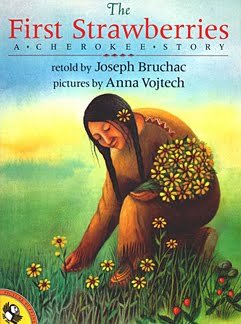
           Two of his children’s books that stuck out to me included The First Strawberries and Raccoon’s Last Race. Like many of his stories, these are two old Native American tales that explain something about nature and the world while also teaching a life lesson. The First Strawberries tells of how this fruit came to be, and I was drawn to it because of its universally applicable lesson that comes out of a seemingly simplistic story. All that happens is an argument between a husband and wife, and while the woman is walking away, she is stopped by the beautiful strawberries and is delayed there long enough for her husband to catch up with her and apologize. However, this story reminded me of all of the things in life that can sometimes get the best of us and cause anger or frustration with those around us. I think this would be a great lesson to talk to students about, because we all have bad days and feel like the world is against us. However, if we just stop to enjoy the little pleasures in life, we realize that we don’t have it that bad after all.
            Raccoon’s Last Race also presents a situation that we can learn from. Azban the raccoon is conceited and boastful of his ability to run faster than the all of the other animals, but that is soon taken away from him when he gets squashed by a boulder during yet another race. According to the tale, this is how raccoons ended up with a flatter body and short legs that are not as suitable for running.
            While I am a bit wary of choosing books that are heavily weighted towards teaching a lesson, I think Bruchac’s books can still be valuable literature in the classroom. Native American legends like these teach us to be a good friend to others and to evaluate where we find meaning in our lives. These are themes which I can ease into the curriculum as a teacher to remind students that we should be respectful of each other, listen when others are speaking, etc. More relevant, however, is the fact that Bruchac’s writing can be utilized within a unit about Native American cultures. Like his Abenaki tribe, a lot of Native Americans use folktales to teach their children and show them the path they should take in life. I think it’s important for students to learn about Native American literature and the purpose behind why these stories have been passed on through the generations. By showing students that Native American tribes use literature to teach life lessons, they can begin to develop a respect and understanding for this element of the Native American culture.